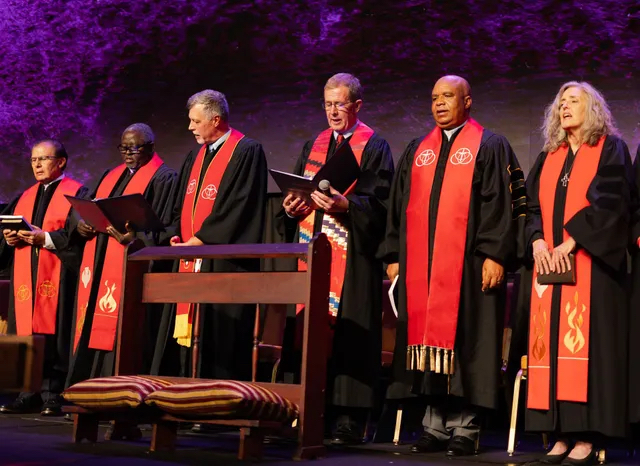
Photo courtesy of the Global Methodist Church
In just a couple of weeks, delegates from across the Global Methodist Church will gather in Johannesburg, South Africa, for the 2026 General Conference. Among the many important decisions before them will be the election of eight bishops who will serve the church for the next six years.
As we approach that moment, I’ve found myself thinking about a simple question: What kind of bishop do we need for this season of the Global Methodist Church?
I’ve had the privilege of getting to know some of our current bishops and some of those who have been nominated for the episcopacy. Others I don’t know personally, so I’ve been reading, listening and learning more about them.
The first thing I want to say is simply this: Thanks be to God!
What an incredible group of men and women God has raised up to serve His Church. They come from different places, cultures and ministry settings. They possess different gifts and experiences. Yet as I’ve learned more about them, I’ve been struck by how much we have to celebrate. These are people who love Jesus, love His Church and have demonstrated a willingness to serve.
I don’t know who my bishop will be when all of this is finished, but looking at the people who have offered themselves for this work, I am grateful. Whatever happens in Johannesburg, the Global Methodist Church has been blessed with gifted leaders willing to say yes.
I know there have been plenty of rankings floating around. I don’t have one. The only number-one power ranking I’m interested in right now is the Chicago Cubs. I’ll let you know if that changes. It won’t.
I’m not going to rank episcopal nominees or tell delegates how they should vote. Frankly, my perspective is far too limited for that. I’m a local church pastor serving primarily in the Northern Kentucky and Greater Cincinnati context. The Global Methodist Church now encompasses more than 7,000 congregations and 48 annual conferences around the world. What I see from my little corner of the connection is only one piece of a much larger picture.
I do know what I’m seeing here, and I know what our own church says a bishop is called to be.
The Global Methodist Church describes bishops as traveling, apostolic leaders called to visionary servant leadership, oversight and supervision in support of the Church’s mission. Episcopal nominees are expected to have demonstrated effectiveness in evangelism, discipleship and mission. Bishops are also entrusted with defending the faith and leading the spiritual and temporal life of the Church.
That sounds like a tall order…. and that’s the point.
We need bishops who keep us focused on evangelism.
This past June, I attended my third Annual Conference in Tennessee. One of the things I have loved about these gatherings is the worship. Every year it has been powerful, and this year was exceptional. There is something beautiful about gathering with brothers and sisters from across state lines, worshiping Jesus together and sensing the presence of the Holy Spirit. It was wonderful.
Then came a moment I haven’t been able to shake.
During one of the sessions, Rev. Dr. Brian Ebel (Episcopal Nominee) of St. Luke Church in Lexington, Kentucky, was giving a report related to church planting. It was after lunch, and we had already listened to several reports, so Brian had everyone stand and stretch for a moment.
Then he gave us another instruction.
“If you are 50 years old or older, sit down.”
People started sitting…and sitting…and sitting. When it was over, it looked to me like roughly 95 percent of the room was seated. There was an audible reaction in the room.
Now, I want to be careful with that number. This wasn’t a scientific demographic study, and I don’t know whether that moment accurately represents the age demographics of my Annual Conference, much less the entire Global Methodist Church… but I know what I saw. Almost everyone was sitting.
It was one of those moments when an illustration stops being an illustration.
We had spent our time praising God for what He was doing among us, and rightly so. I love this church. I’m excited about the Global Methodist movement. I believe God is doing something wonderful among us. Looking around that room reminded me of something we cannot afford to forget:
Evangelism is not something we can get around to later. Evangelism is now.
We have to reach people for Jesus Christ. Children. Teenagers. Young adults. Young families. People who have never stepped inside a church. People who walked away years ago. People who know nothing about Methodism and frankly don’t care about our denominational debates. They need Jesus and we have been entrusted with the gospel.
Interestingly, this concern is already showing up within our denominational leadership. The Kingdom Advancement Commission’s February 2026 meeting minutes noted that much of the GMC’s expansion from just over 4,000 to more than 7,000 churches came through denominational transfers and said long-term vitality requires evangelism, new believers and disciple-making. The commission also highlighted the need for bishops with apostolic gifts and histories of equipping and multiplying disciples.
That gets my attention. An extraordinary amount of work has been done to form the Global Methodist Church for God’s kingdom. Now we need to advance His Kingdom.
We need bishops who recognize that ministry doesn’t look the same everywhere.
Here’s another challenge I see.
Denominations have struggled across the American religious landscape for decades. The reasons are complicated, and I’m certainly not going to solve them in a blog post. But I wonder if one problem emerges whenever a system becomes larger and larger.
Wet concrete can be shaped. Hardened concrete can’t.
Organizations can become like that.
Policies accumulate while structures solidify. Programs become standardized and before long, something originally designed to support ministry can make adapting ministry increasingly difficult.
One of the things I hope we protect in this young denomination is the ability of the local church to respond faithfully to what God is doing in its particular mission field. Interestingly, our own Book of Doctrines and Discipline says disciples are made at the local church level and directs the General Conference to keep as many resources there as possible so the Church can accomplish its mission.
A house church isn’t a country church. A country church isn’t a suburban church. A new church plant isn’t a 150-year-old congregation. A congregation of 70 people doesn’t face the same opportunities and challenges as a congregation of 700 or 7,000.
Yet, Jesus is Lord of every one of them.
That means episcopal leadership cannot simply hand every congregation the same blueprint.
We need bishops capable of walking into very different ministry contexts and asking, Where is God moving here? How can I encourage it? How can the connection resource it? How do we remove unnecessary obstacles without compromising who we are?
I was reminded of this recently while sitting with a couple of pastors talking about discipleship. We compared what we were doing in our churches, and our systems were quite different.
Near the end of the conversation, one of the pastors pointed something out. Essentially, he said, “It’s clear all of us have different systems for making disciples…but we’re all making disciples.”
Hallelujah!
That’s it. I don’t need every Global Methodist congregation to look like mine. I don’t even need them to use the same discipleship system I use. I want them to make disciples. And I want bishops who can recognize and celebrate the movement of God whether it happens in a living room, a country chapel, a church plant, a downtown congregation or a large suburban church.
We need bishops who keep us within the guardrails.
Flexibility without theological boundaries eventually becomes something else entirely.
This is where episcopal leadership matters tremendously. We don’t need bishops deciding that every church should look the same. However, we do need bishops helping ensure that wherever Global Methodists gather, we remain Global Methodists.
Our church is intentionally rooted in Scripture, the historic creeds of the Church and the Wesleyan theological tradition. The GMC describes Scripture as the primary authority against which other authorities are measured, and its doctrinal standards deliberately locate us within historic Christian orthodoxy. Those are our guardrails. Inside those guardrails, there ought to be tremendous creativity.
Plant churches differently. Organize discipleship differently. Worship in different settings. Reach different communities. Try things that don’t work and learn from them. Follow the Holy Spirit into places we haven’t been before but…
Keep us inside the guardrails and keep pointing us toward the mission.
When I think about the bishops we need for this next season, then, I want bishops who continually turn our attention outward. Leaders who guard the faith without extinguishing creativity. Leaders who can recognize the movement of the Holy Spirit in ministry settings completely different from their own. Leaders who celebrate baptisms, professions of faith, church plants, revitalized country churches, new discipleship movements and faithful established congregations.
I don’t think that’s easy. In fact, maybe that’s why it calls for a bishop. I don’t need a bishop who has all the answers. I need one who keeps reminding me why we’re here. Our mission is beautifully simple: to make disciples of Jesus Christ and spread scriptural holiness across the globe.
That mission is too important to become something we simply print on our websites. It has to become the heartbeat of our movement.
And maybe that moment in Tennessee was a gift to me. Hundreds of faithful Methodists sitting down in a room wasn’t a reason for despair. Quite the opposite. I looked around and saw people who have prayed, served, sacrificed, planted churches, preached the gospel and carried the faith for decades.
As General Conference approaches, I’m praying.
I’m praying for the bishops currently serving, including those completing their episcopal service. I’m praying for all 24 people who have accepted nomination, because offering yourself for this kind of discernment requires courage and humility. Finally I’m praying for the eight who will be elected, I’m also praying for the sixteen who won’t be.
May they leave Johannesburg knowing that an election result never determined the value of their ministry or the significance of their calling. May God continue using every one of these gifted men and women for the work of His Kingdom.
Whoever wears the mantle of bishop in this next season, my prayer is simple:
Keep us faithful to the faith once delivered. Give us room to follow the Holy Spirit. And never let us forget the people who don’t know Jesus yet.
That’s the kind of episcopal leadership I pray God gives the Global Methodist Church for this season.


Leave a Reply